
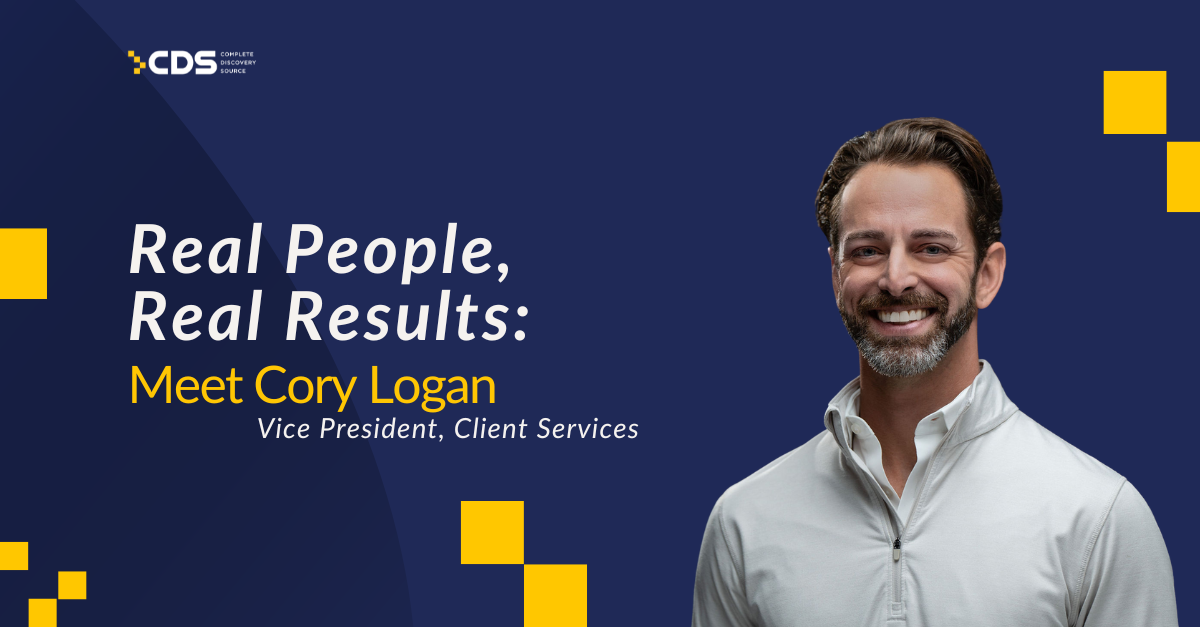
At CDS, we let the work speak for itself. But behind every result is a team member that made it happen. Real People, Real Results is a monthly series that takes a closer look at the individuals who make up our team, exploring their backgrounds, their expertise, and what drives them.
With more than 12 years at CDS, Cory Logan, Vice President of Client Services, has built his career around helping clients navigate the evolving complexities of eDiscovery with clarity and confidence. In his role, Cory leads more than 60 professionals across two divisions, overseeing multiple eDiscovery hosting solutions while driving the operational and strategic growth of commercial accounts. His approach combines deep industry expertise with innovation, collaboration, and a strong focus on creating exceptional experiences for both clients and teams.
A recognized expert in eDiscovery and privacy, Cory brings a forward-thinking, people-first perspective to every engagement. He is passionate about using technology, process automation, and creative problem-solving to tackle complex challenges while staying grounded in transparency, empowerment, and collaboration. That combination of technical expertise and relationship-driven leadership has made Cory Logan a trusted partner to clients and an influential voice within CDS and the broader eDiscovery community.
What fictional character do you relate to most, and why?
I’d probably go with Tony Stark. Not necessarily for the billionaire-superhero lifestyle, although I wouldn’t turn it down, but for the builder and problem-solver mentality. I’m always looking at how something works, how it could work better, and what I can do to get it there. I’m not particularly good at accepting “that’s just the way it is,” and I’ll usually keep pushing until I find a solution.
At the end of the day, though, what resonates most is the evolution of Stark’s character: success becomes less about what he can accomplish for himself and more about what he can build, improve, and provide for the people around him. That combination of curiosity, persistence, a little obsessiveness, and a genuine investment in others feels pretty familiar.
How do you create an environment where people feel comfortable speaking honestly, challenging an idea, or asking for help?
For me, it starts with making sure people know that disagreement isn’t disrespect. I don’t want a room full of people who simply agree with me. I want people who are willing to tell me when they see something differently, especially when I might be wrong. That only works if leaders are willing to listen, admit when they don’t have the answer, and occasionally change course because someone raised a better idea.
The same applies to asking for help. I’d much rather someone raise their hand early than struggle quietly because they’re worried about how it might be perceived. I try to create an environment where questions, challenges, and even mistakes are treated as opportunities to solve something together rather than assign blame. Over time, I think people learn whether it’s truly safe to speak up based less on what you tell them and more on how you respond when they actually do.
What is something people are usually surprised to learn about you?
People are usually surprised to learn how much I enjoy disconnecting and getting outdoors, particularly backpacking and multi-day thru-hiking. I ran track in high school, but it was training for and completing the 2016 NYC Marathon that really pulled me back into outdoor activities. Over time, that evolved from running into hiking and eventually multi-day trips where everything I need is on my back and the goal is simply to keep moving forward.
There’s something about being in nature that has always served as an anchor for me. We live in a world of constant information, notifications, and an endless push toward more; more things, more productivity, more consumption. Getting away from all of that, even for a few days, has a way of stripping life back to the basics and helping realign your perspective. Your priorities become pretty simple: where you’re going, what you need, the people you’re with, and occasionally wondering why you thought carrying a backpack up another mountain was a good idea.
What career or profession would you be if you weren’t the VP of Client Services at CDS?
I’d be an artist, preferably living somewhere near a beach. I’ve always been drawn to creative expression, whether it’s drawing, sculpting, glassblowing, or photography. What interests me most is the ability to take something from the natural world or the human experience and interpret it in a way that captures something real: an emotion, a moment, a personality, or even an imperfection. I think there’s something powerful about art that doesn’t just show us how things look, but reveals something about who we are.
It may seem like a pretty big departure from Client Services, but I think the underlying motivation is actually similar. I enjoy creating things, looking at something from a different perspective, and turning an idea into something tangible. The biggest difference is that in this version of my career, I’d hopefully be doing all of that from a studio overlooking the ocean.
As technology takes on more of the process, which human qualities will become even more valuable?
I think empathy, curiosity, judgment, and the ability to build genuine relationships will become even more valuable. Technology can make us faster, more efficient, and increasingly capable of solving complex problems, but it still matters how we understand the people behind those problems. Being able to listen, recognize what someone actually needs, ask the right questions, and understand the nuances that aren’t always captured in the data will continue to differentiate great people and great teams.
I also think curiosity becomes increasingly important. As technology takes over more of the “how,” our value shifts toward asking “why,” challenging assumptions, and thinking creatively about what’s possible. The best technology still needs people who can apply judgment, provide context, and know when the obvious answer isn’t necessarily the right one.
Ultimately, I don’t think the future is about humans competing with technology. It’s about using technology to give us more time and capacity for the things humans do best: connecting with people, thinking critically, creating, leading, and making thoughtful decisions when the answer isn’t black and white.
What’s something you’ve changed your mind about as you’ve gotten older?
I’ve learned to place a lot less importance on what other people think of me. That doesn’t mean their opinions don’t matter; consideration, self-awareness, and understanding how we impact others are incredibly important. But there’s a big difference between considering someone else’s perspective and allowing it to determine who you are.
When we spend too much time trying to meet other people’s expectations, we can unintentionally limit our own potential. We make ourselves smaller, avoid taking chances, or bend parts of ourselves into what we think the world wants us to be. As I’ve gotten older, I’ve become much more comfortable simply being myself and trusting that the parts of me that are meant to shine will do so.
There’s a certain freedom that comes with that. Life becomes a lot easier when the person you present to the world is the same person you actually are. Not everyone will understand you or connect with you, and that’s okay. The goal isn’t to be everything to everyone. It’s to be genuine, continue growing, treat people well, and surround yourself with people who appreciate you for who you actually are.
We’re glad you took the time to meet Cory Logan! Look out next month as we highlight more of the real people driving real results at CDS. To learn more about CDS, reach out to us at .
