
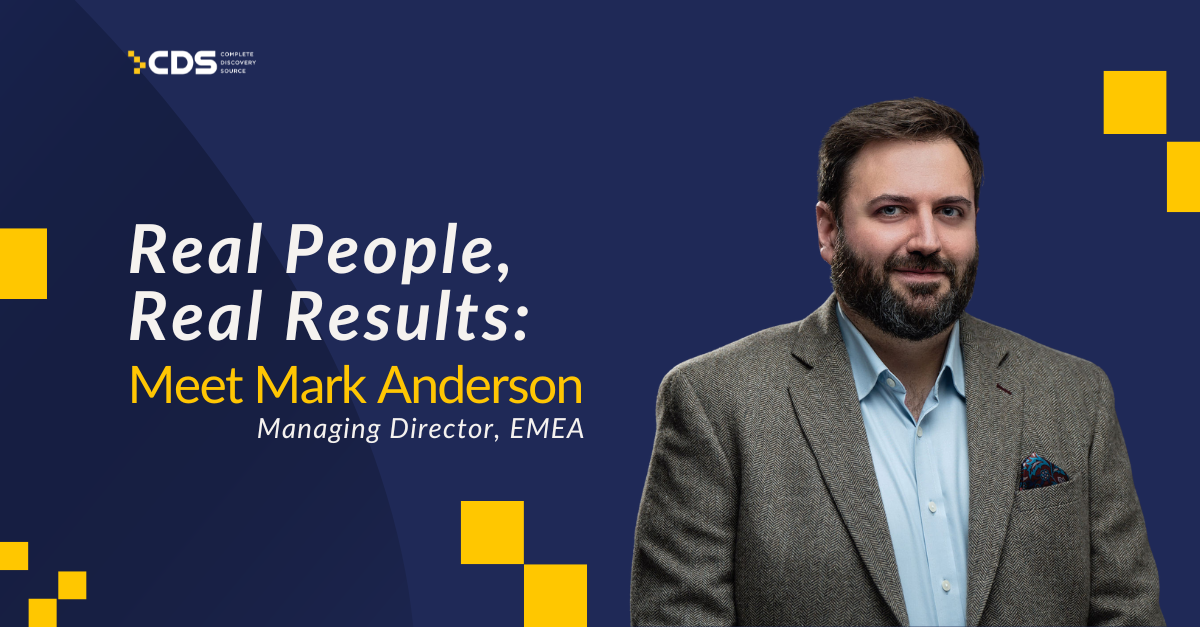
At CDS, we let the work speak for itself. But behind every result is a team member that made it happen. Real People, Real Results is a monthly series that takes a closer look at the individuals who make up our team, exploring their backgrounds, their expertise, and what drives them.
This month, meet Mark Anderson, Managing Director, EMEA. With extensive experience in eDiscovery, computer forensics, and emerging technologies, Mark helps clients navigate complex matters involving challenging data types, large-scale workflows, and evolving discovery requirements. His expertise spans the full eDiscovery lifecycle, and he is particularly known for his ability to develop practical, efficient solutions for some of the industry’s most demanding cases.
A trusted advisor in both traditional and next-generation eDiscovery technologies, Mark specializes in advanced data handling, conversion, analysis, and generative AI solutions, including Relativity aiR and proprietary GenAI tools. Backed by industry-leading certifications such as Relativity Master, Certified E-Discovery Specialist (CEDS), EnCase Examiner, and Project Management Specialist, Mark Anderson combines deep technical knowledge with a strategic, client-focused approach. His ability to translate complex challenges into effective, scalable workflows makes him a valuable resource for clients and colleagues alike, not just in the United Kingdom, but across the world.
Tell us about your career journey. What first drew you to eDiscovery and computer forensics?
I think this is a common story in that I just fell into it. This isn’t a career you dream about as a kid, and most people wouldn’t even know what it is without having it explained to them. Although, I think computer forensics is becoming more mainstream through TV and films, albeit a very stylised version of it.
When I first got into eDiscovery, I had graduated from university attempting to build a career within the media industry, specifically film, where I was looking to focus on behind-the-scenes work such as editing. Unfortunately, that never panned out, and I obtained an administrative job at a consultancy. It was there that I met the eDiscovery and forensics team at a Christmas party and speaking to them about what they did sparked my interest. I had always been interested in computers, and they seemed to come naturally to me. The team told me they were always busy and a week later I was being trained in our lab on how to carry out forensic imaging. A month or so later I was asked to transfer departments, and just one week after moving across, I was asked to go to Copenhagen, where I spent six weeks working on a huge project imaging devices and running behind-the-firewall eDiscovery projects using Clearwell.
It was very much a baptism by fire, and I don’t think that ever really changes in this industry, where every week is a new challenge.
Generative AI is transforming the industry. What opportunities are you most excited about for clients?
I think AI is changing the world and, while it is filled with positives, our staff and clients need to be aware of the pitfalls as well.
I would treat AI in much the same way as I would treat staff and processes when involved in high-stakes matters such as legal cases. No company should simply jump in and use AI without considering how it will be used, and putting appropriate quality control in place. Whether you are asking a new member of staff to run a workflow or a paralegal to review documents, instructions and feedback are key, alongside robust quality control processes. Like a human, if feedback isn’t provided, AI won’t necessarily learn from its mistakes and may continue doing something incorrectly until it is corrected.
Another area of concern that I think we are going to see more of is the falsification of documents. People are already aware of deepfakes, but I am seeing some amazing replication of documents, images, receipts and other materials. I think this is going to become another area of evidence that may need to be investigated as part of cases.
On the positive side, we are already seeing huge savings in both time and cost for our clients through Relativity aiR to automate review, and finding key documents quickly, or with CDS Vision to make documents searchable that previously weren’t, whether through AI OCR, or image summarization and object detection.
The main thing I am looking forward to is AI becoming faster and the costs continuing to decrease, with AI being ready to work on your data almost immediately. Some of this is already available through aiR Assist, where you can ask natural-language questions about your data. But imagine setting up profiles where AI has already categorised your data, identified the junk, identified potentially privileged documents, found your key documents and perhaps even identified other cases or issues you should be aware of.
For most cases, it could be a game changer when it comes to culling data and finding the important information. But imagine the compliance benefits if AI could simply look across your data continuously and detect problems as they are happening. If we look at how quickly technology evolves, especially when boosted with AI, I think we will be having monumental shifts yearly.
What do you hope clients feel after working with you and your team?
In the past, I’ve worked for both small and large eDiscovery firms. I have always found that the smaller organisations tend to be much more client-centric, more technically minded when it comes to solving issues and focusing on providing the best possible service, with genuine care for clients.
Joining CDS, an organisation focused solely on eDiscovery and forensics, still has the feel of a smaller organisation while being one of the largest RelativityOne providers globally. I think that comes down to CDS being privately owned, the culture and having a problem solving mindset underpinned by seasoned experts and I think our clients feel that.
Often, our clients come to us with issues around eDiscovery, software gaps, slow speeds, collection challenges, reporting and even billing complications. They sometimes think these are just part and parcel of the process or a limitation of the technology, but don’t necessarily realise that they can be the result of antiquated ways of working, old technologies, too many departments and teams that don’t communicate effectively, or processes where people aren’t fully trained throughout the workflow. There can also be a tendency for service and attention to increase only when you are paying more or dealing with a larger case.
I think our clients walk away from engaging with us with a smoother process, the best technology, both out of the box and through our proprietary solutions, but above all, with a team that is not only highly skilled but genuinely cares about their experience and the outcome of their matters, regardless of the size or value of the case.
What’s the best concert or live event you’ve ever been to?
That’s a difficult one, as I’m a big music fan. My first ever concert was Green Day at Wembley Arena, which was amazing. However, I’ve seen them multiple times since in much smaller and more intimate venues which are much better than arena tours in my opinion, I also love the bands Muse and Billy Talent and need to get back into seeing gigs more regularly.
I would probably say the best overall experience was Reading Festival 2003. This was my first festival, and it still has one of the best line-ups I can remember from any festival. It was headlined by Linkin Park, Metallica and Blur, with support from System of a Down, Blink-182, Sum 41, Less Than Jake and countless other big bands, or bands that went on to become huge. It was an amazing experience and definitely one that has stuck with me and when I show people the line up they are shocked.
Outside of music, I would also say that London 2012 was an amazing experience when the city hosted the Olympics. It was great watching the country come together, getting to see multiple events, and experiencing the atmosphere around the city. I particularly remember watching the Olympic torch handovers and the athletes’ parade go through the streets of London which at the time we could see from our office, hanging out the second floor windows watching, and experiencing that incredible sense of community.
What energizes you outside of work?
My team would laugh at me because they are probably bored of hearing about it, but I have been renovating my house for the past eight years. While it wasn’t dilapidated, it’s a house from the 1950s, so it needed a lot of modernising. I try to do a lot of the work myself, although I’m certainly better at the big jobs than the small finishing touches.
The problem is that after eight years, I’m now having to replace some of the things I did eight years ago. I was warned that it’s a never-ending circle, and they were absolutely right.
Outside of that, I travel a lot for work, so I like to take it easy where possible. I have a six-year-old Border Collie, so I spend around two hours a day either in the park, in a forest, or I am luckily walking distance from beaches.
Unfortunately, with the UK winter coming in, that’s going to have to reduce to evening walks as the nights draw in. The dog walks are great, though. They get me away from my desk, give me some time to clear my head, get a little exercise, listen to music or podcasts, and switch off from work for a while.
Where do you see the biggest opportunities for CDS to create more value for clients over the next few years?
As systems become more self-service and AI makes finding and integrating data easier, I see CDS’ experience providing the biggest value for clients.
I work with a lot of clients who have Managed Service matters and are perhaps 80% self-sufficient in managing their matters themselves. However, they turn to us for the 20% that is heavily complicated, requires custom development or scripting, or needs experience that can typically only be learned by being in the trenches.
That includes our experience in managing forensics, extracting data from complicated systems and encrypted applications, and understanding how new technologies such as Generative AI can be integrated into their workflows to drive the best possible outcomes.
I think that’s where CDS can really add value: not necessarily by doing everything for the client, but by being there when they reach the complicated parts of a matter where experience, technical expertise and problem-solving really make a difference.
We’re glad you took the time to meet Mark Anderson! Look out next month as we highlight more of the real people driving real results at CDS. To learn more about CDS, reach out to us at .
