
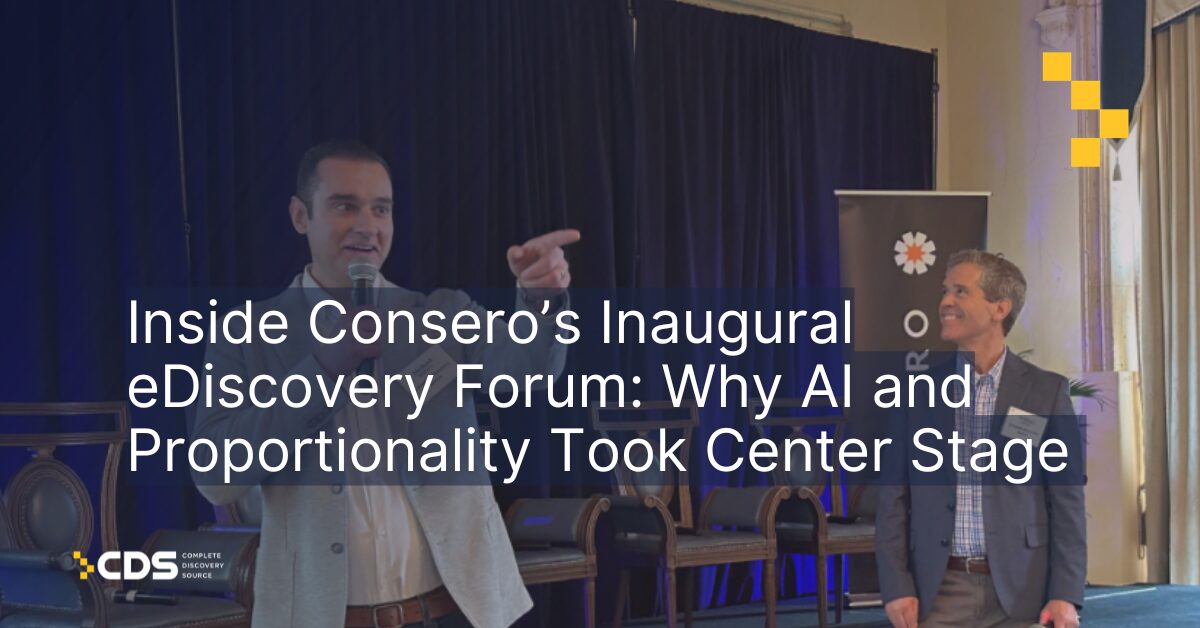
Consero recently hosted its inaugural eDiscovery Leadership Forum, the first in a new series of events designed specifically for the eDiscovery community, expanding beyond legal operations to bring together legal, technology, and litigation leaders in one room.
Unlike traditional conferences, the forum was built for open, focused, peer-level discussion. Complete Discovery Source) was proud to participate through our long-standing partnership with TRU Legal, a collaboration that has spanned more than two decades and continues to focus on practical, defensible discovery strategy.
A KnowledgeBridge Conversation, Not a Presentation
One of the forum’s featured discussions was a CDS-led KnowledgeBridge session examining how generative AI is colliding with one of discovery’s most foundational principles: proportionality.
Rather than delivering a single narrative, the session was intentionally structured as a point–counterpoint conversation, reflecting the reality that legal, technical, and practical perspectives don’t always align, and shouldn’t.
“Proportionality hasn’t changed as a legal concept,” noted Bill Belt, who guided the discussion from a legal and judicial perspective. “But the assumptions behind it were built on human review economics. When those economics shift, the arguments have to be reexamined.”
Bill’s role anchored the conversation in legal precedent and judicial expectations, emphasizing that while the doctrine remains intact, the way it’s argued and evaluated may be entering new territory.
From Review Speed to Real Answers
From the technical side, Vice President of eDiscovery Products & Solutions, Michael Milicevic Esq. walked participants through the evolution of AI in eDiscovery, from early analytics and TAR to today’s generative models, highlighting the importance of process and defensibility regardless of the underlying technology being used.
“Different engine, same defensible framework,” said Michael Milicevic. “We should embrace evolving AI technologies and the efficiencies they unlock, so long as their use remains grounded in proven review methodology and validated through defensible human oversight.”
That shift reframed proportionality around outcomes rather than volume, prompting attendees to rethink how effectiveness, risk, and defensibility should be measured in an AI-driven workflow.
Why AI + Proportionality Resonated
As the discussion unfolded, it became clear why the discussion gained immediate traction.
Generative AI has evolved beyond prioritizing documents. It can now analyze massive datasets, surface themes, and deliver answers in a fraction of the time traditional review required. That reality raises uncomfortable but necessary questions:
- If review costs drop dramatically, does “unduly burdensome” still mean the same thing?
- Does faster review expand what’s reasonable or simply introduce new risks?
- And are proportionality arguments keeping pace with the technology teams are already using?
These questions sparked lively debate among in-house counsel, law firms, and technologists in the room, exactly the kind of exchange Consero set out to create.
The New Discovery Math
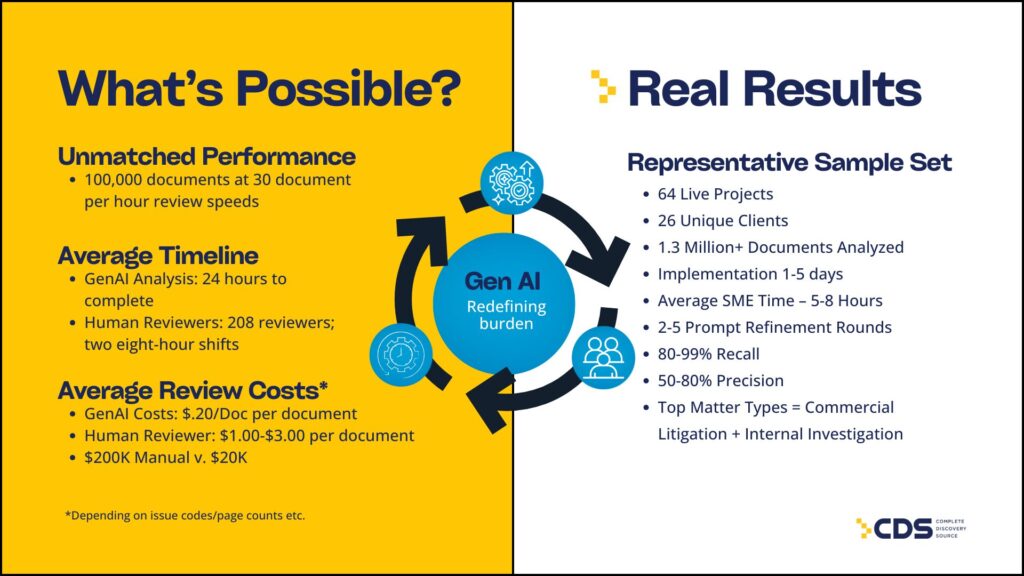
To ground the conversation, CDS shared real-world benchmarks from live matters where generative AI has already been responsibly deployed:
- Hundreds of thousands of documents analyzed in roughly 24 hours
- Review costs reduced by up to 80% compared to traditional models
- High recall supported by expert oversight and iterative validation
The data wasn’t presented as a prescription, but as a reality check on how quickly the economics of discovery are shifting, whether teams are ready or not.
What This Signals for the eDiscovery Community
The forum closed with more questions than answers, and that was by design.
Like earlier technology advancements, in particular TAR, GenAI applications and identified use cases are advancing faster than case law and at times, best practices. The key difference is the depth of penetration. Many users have already deployed GenAI for a wide variety of legal ops and eDiscovery tasks. Consero’s inaugural eDiscovery Forum created space for the community to explore these issues together, openly and thoughtfully.
For those who couldn’t attend, this discussion is just getting started. The questions raised during the session will continue to shape CDS’ thinking and future conversations around AI, proportionality, and defensible discovery. As courts, technology, and expectations evolve, we’ll be exploring what modern proportionality really looks like—and sharing more along the way.
If AI is changing your discovery strategy, this is a conversation you’ll want to follow, and a forum you’ll want to be part of in the future.
